
This website contains imagery that is only suitable for audiences 18+. Any surgical or invasive procedure carries risks.
An Arm Lift (brachioplasty) is a surgical procedure that may be considered to address excess skin and/or tissue of the upper arms. Some people seek assessment after significant weight change, ageing-related skin laxity, or when exercise has not changed the appearance of loose skin. The procedure involves incisions and results in scarring. A consultation is required to confirm suitability and to discuss expected changes and limitations, scarring, risks, recovery, and alternatives.
Brachioplasty is a body contouring operation that removes excess skin and, in selected cases, excess fatty tissue from the upper arm. The incision pattern depends on the amount and location of excess skin and may extend from the underarm toward the elbow. In some cases, liposuction may be used as part of the surgical plan where clinically appropriate.
All surgery results in scars, and scar visibility varies between individuals.
The goals of brachioplasty depend on anatomy, skin quality, and the agreed surgical plan. Depending on individual circumstances, potential physical outcomes may include:
– Reduction of loose upper-arm skin: where clinically appropriate.
– Change in upper-arm contour: results vary and depend on skin elasticity and healing.
– Clothing comfort considerations: some people report changes in how sleeves fit; this varies.
– Skin-fold symptom considerations: in some individuals, reducing skin-on-skin friction may help with irritation; this varies.
Outcomes vary and no specific result can be guaranteed.
A suitable candidate is generally an adult seeking assessment for upper-arm skin laxity and/or excess tissue, and who is in good overall health. Suitability depends on general health, nutritional status, smoking status, weight stability, skin quality, and individual risk factors. Candidates should have realistic expectations about scarring, recovery time, and variability in outcomes. A consultation is required to confirm suitability.
You May Be a Good Candidate If
You may be a good candidate for an arm lift if you:
– Have excess upper-arm skin that you would like assessed
– Have stable weight (where relevant to surgical planning)
– Are in good overall physical health
– Do not smoke or are willing to stop nicotine use for a specified period before and after surgery (as directed)
– Understand that scarring is expected and outcomes vary
– Are willing to follow post-operative instructions and attend follow-up appointments
Brachioplasty may not be suitable for individuals who:
– Have uncontrolled medical conditions that increase surgical risk
– Have an active infection
– Are unable to stop nicotine use where clinically required (as nicotine can impair healing)
– Have unstable weight or are planning major weight change in the near future (timing may be deferred depending on clinical advice)
– Have unrealistic expectations about scarring, symmetry, or outcome variability
– Have a history of problematic scarring or wound healing issues (assessment required)
The technique is individualised based on the degree and location of skin excess and the distribution of fatty tissue. Options may include:
– Limited-incision brachioplasty: may be considered when skin excess is mild and mainly near the underarm.
– Standard brachioplasty: commonly involves an incision along the inner or back aspect of the upper arm; the length varies with the amount of skin removal required.
– Brachioplasty with liposuction (selected cases): liposuction may be used to address fatty tissue where appropriate, either as part of the arm lift or as a staged approach.
Your surgeon will explain incision placement, expected scarring, trade-offs, and whether additional procedures are recommended during consultation.
Anesthesia
Brachioplasty is commonly performed under general anaesthesia, though local anaesthesia with sedation may be considered in selected cases depending on the extent of surgery and facility protocols. The anaesthesia plan will be discussed during consultation.
Preparation typically includes:
– Medical review: health history, medications and supplements, and relevant investigations where required.
– Medication guidance: you may be asked to stop certain medications/supplements that can increase bleeding risk (where clinically appropriate).
– Nicotine cessation: nicotine can impair healing; you may be asked to stop smoking/vaping/nicotine products for a specified period before and after surgery.
– Fasting instructions: follow the facility’s requirements prior to anaesthesia.
– Support planning: arrange transport and post-operative support after discharge.
Return to Work: Timing varies depending on the extent of surgery and the physical demands of your role.
Return to Exercise: Light activity may be resumed as advised. Strenuous exercise, heavy lifting, and upper-body training are typically restricted for a period determined by your surgeon.
Appearance over time: Swelling reduces gradually and scars mature over months. There is no single timeline that applies to everyone.
The outcomes shown are only relevant for this patient and do not necessarily reflect the results other patients may experience, as results may vary due to many factors including the individual’s genetics, diet and exercise.
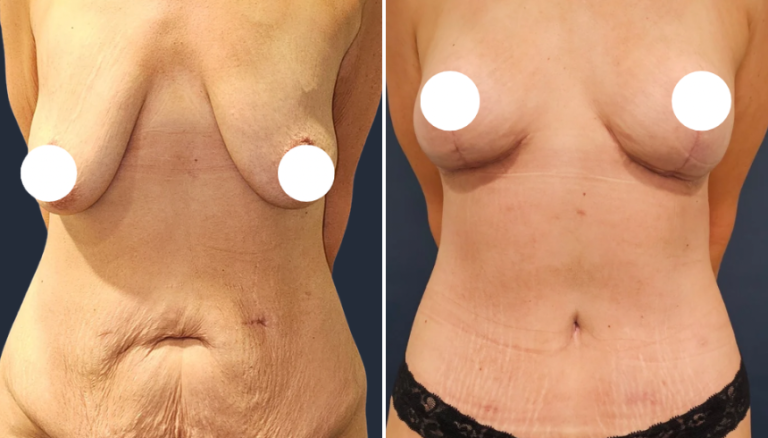
Procedure: Abdominoplasty, Breast Lift
Recovery Timeline: 3 Months