
This website contains imagery that is only suitable for audiences 18+. Any surgical or invasive procedure carries risks.
An extended tummy tuck (extended abdominoplasty) is a body contouring procedure used to address excess skin and soft tissue across the abdomen and extending towards the hips and flanks (and in some cases further around the lower back). It is most commonly considered after significant weight loss or pregnancy-related changes where skin laxity is not improved through non-surgical measures. The goals are to improve contour and, in selected patients, support comfort by reducing skin fold-related issues. A consultation is required to confirm suitability and surgical planning.
An extended tummy tuck involves removal of redundant skin and soft tissue from the lower abdomen with a longer incision than a standard abdominoplasty, allowing additional contouring of the flanks. In appropriate cases, the procedure may also include repair of abdominal wall separation (diastasis recti) by tightening the underlying muscle fascia. Liposuction may be used selectively to refine contour, but it does not replace skin excision where laxity is significant. This is major surgery and requires a recovery period and acceptance of permanent scarring
Potential benefits vary depending on anatomy, skin quality and healing. They may include:
– Reduction of excess abdominal skin and improved lower abdominal contour
– Improved contour through the flanks/hips compared with a standard tummy tuck in selected patients
– Abdominal wall tightening (when diastasis repair is performed and clinically appropriate), which may improve core support for some patients
– Reduced skin-fold irritation in some cases where redundant skin contributes to chafing or hygiene difficulties
– Improved clothing fit for some individuals
– Outcomes differ between individuals and cannot be guaranteed.
A suitable candidate is typically an adult who:
– Has stable weight (often after significant weight loss) and is not using surgery as a weight-loss method
– Has excess skin that extends beyond the central abdomen to the hips/flanks
– Is medically fit for surgery and recovery
– Does not smoke/vape or can stop nicotine use for the clinically required period
– Understands the trade-offs, including longer scars, recovery time, and variable results
You May Be a Good Candidate If
You may be a good candidate if you:
– Are in good overall health
– Have persistent excess skin and tissue through the abdomen and flanks
– Have maintained a stable weight for a period advised by your surgeon
– Have realistic expectations about scarring and recovery
– Are willing to follow pre- and post-operative instructions, including nicotine cessation if required
– Have concerns about abdominal wall laxity/diastasis that can be assessed during consultation
An extended tummy tuck may not be appropriate if you:
– Are planning pregnancy in the near future (this may affect results, particularly if muscle repair is performed)
– Have uncontrolled medical conditions that significantly increase surgical risk
– Are unable to stop nicotine use as directed (this increases complication risk)
– Have significant ongoing weight fluctuations
– Expect a scar-free or “perfect” outcome, or are seeking surgery primarily for weight loss
Technique selection depends on the distribution of excess skin, scar preference, and clinical considerations. Options may include:
– Extended Abdominoplasty Incision: A low incision across the lower abdomen that extends further toward the hips/flanks than a standard tummy tuck, designed to address lateral laxity.
– Diastasis Repair (when indicated): Tightening of the abdominal wall fascia to address separation, where appropriate.
– Adjunct Liposuction: May be used in selected areas to refine contour; not appropriate in every case.
– Vertical Component (Fleur-de-Lis): In selected patients with significant vertical laxity, an additional vertical incision may be recommended to improve tightening (with a more visible scar).
Your surgeon will explain the proposed incision pattern, expected scar location, and the trade-offs of each approach.
Anesthesia
Extended abdominoplasty is most commonly performed under general anaesthesia in an appropriate facility. Anaesthesia is administered and monitored by a qualified anaesthesia clinician.
You will receive individualised instructions. Common requirements may include:
– Medication and supplement review, including agents that can increase bleeding risk
– Nicotine cessation for the recommended period before and after surgery
– Pre-operative tests/clearances if indicated
– Planning transport, time off work, and home support
– Fasting instructions prior to anaesthesia
Return to Work: some patients with sedentary work return in around 2–3 weeks, but this varies.
Return to Exercise: light walking is often encouraged early; heavy lifting, strenuous exercise and core-focused activity are commonly restricted for around 6 weeks or longer, depending on the repair performed and healing.
Assessing longer-term outcome: swelling and tissue settling can take months; results are commonly assessed over 6–12 months, with scars continuing to mature beyond this.
The outcomes shown are only relevant for this patient and do not necessarily reflect the results other patients may experience, as results may vary due to many factors including the individual’s genetics, diet and exercise.
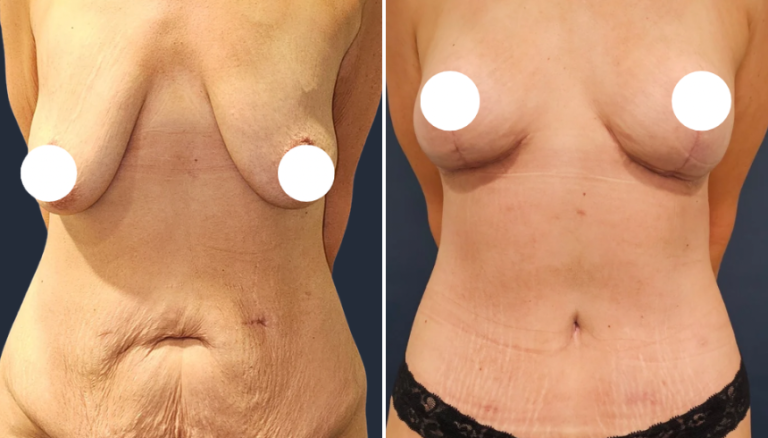
Procedure: Abdominoplasty, Breast Lift
Recovery Timeline: 3 Months